Expanding Our Universe
Hi! My name is Jonathan, and I’m a high school student with a deep passion for astronomy and astrophysics. I created this website to share my journey of learning about the universe, from studying at summer programs to developing my own astrophotography skills.
At Stevenson High School, I am taking or will take advanced coursework including Calculus B&C, AP Physics I, II, and C. I also plan to take an astronomy class online at a community college to further deepen my knowledge. Looking ahead, I aim to participate in the USA Physics Olympiad (USAPhO) and the USA Astronomy and Astrophysics Olympiad (USAAAO), both of which challenge students to apply scientific thinking to complex problems. I have also qualified for AIME multiple times and received AMC 10 Distinguished Honor Roll and AMC 12 Honor Roll.
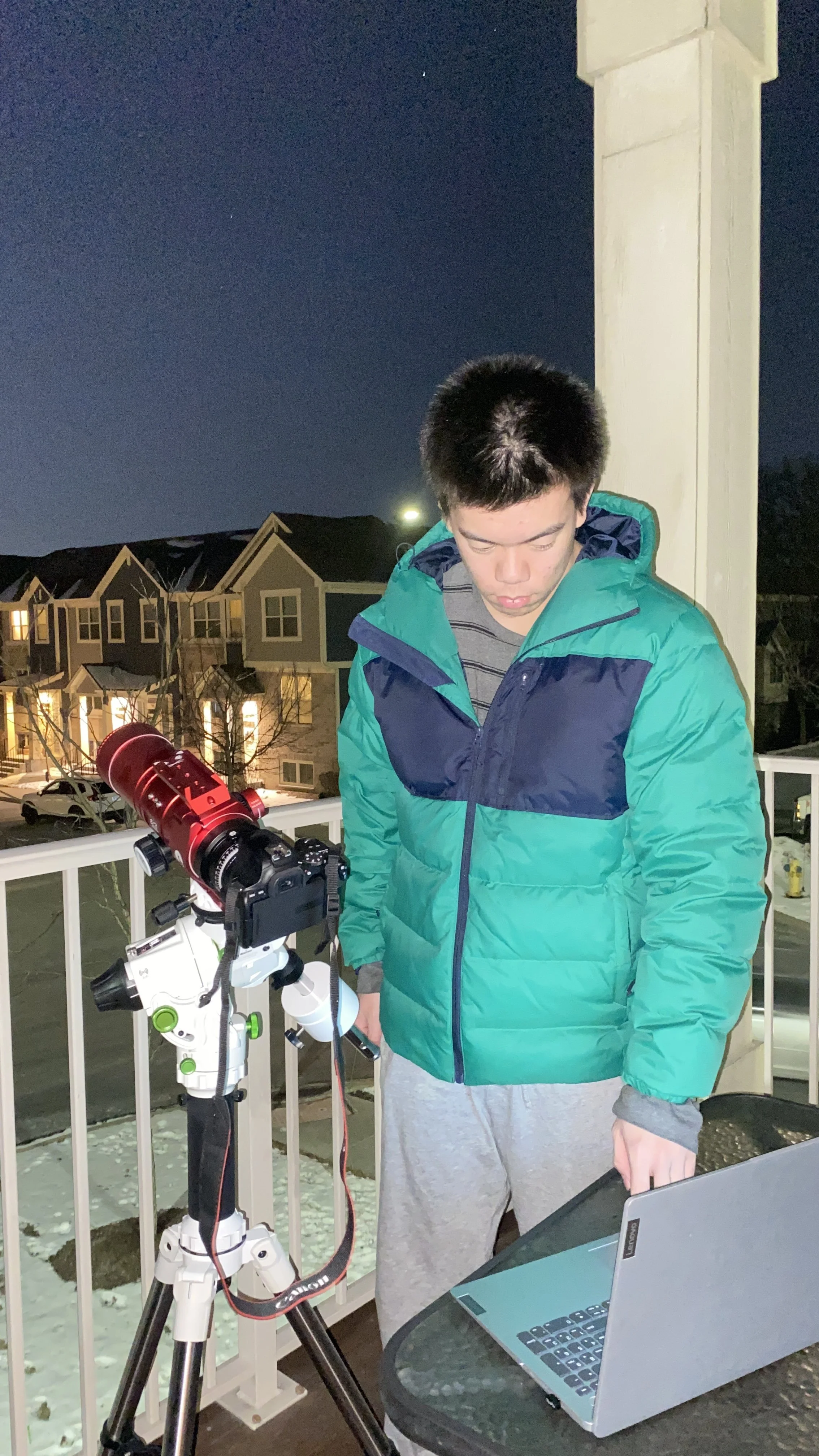
Beyond school, I spend time reading astronomy books, following online lectures, and studying astrophysics topics on my own. I am especially excited to begin astrophotography—capturing images of the Moon, planets, and deep-sky objects. My long-term goal is to contribute to astrophysics research, particularly in the search for habitable worlds.
🌌 Experiences & Programs
Boston Leadership Institute – Astrophysics Program (Summer 2024)
In this three-week program, I explored topics such as exoplanet detection methods, black holes, and stellar evolution. One of the highlights was learning about the direct imaging of the exoplanetary system HR 8799. Seeing real images of planets orbiting another star, as shown in this video by Professor Jason Wang from Northwestern University, was awe-inspiring. It demonstrated how astronomers can actually track planets moving around another star — a discovery that strengthened my interest in exoplanet research.
Zooniverse – Citizen Science Projects (Ongoing)
I volunteer on Zooniverse, a platform that allows anyone to contribute to real scientific research. I am especially drawn to projects in the physics and astronomy sections, where citizen scientists help analyze real data from cutting-edge research.
So far, I have contributed to five projects:
Chicago Astronomical Society – Meeting with Dr. Jim Sweitzer (September 2025)
I recently joined the Chicago Astronomical Society and attended my first event, a presentation by Dr. Jim Sweitzer titled “Introduction to the Rubin Observatory and its Mission”. After the talk, I had the chance to speak with Dr. Sweitzer personally, who gave me a memorable introduction to the astronomy community.
The Vera C. Rubin Observatory is unique because it will create the most detailed time-lapse movie of the sky, capturing the entire visible sky every few nights with its massive 8.4-meter mirror and 3.2-gigapixel camera. Unlike the James Webb Space Telescope (JWST), which looks deep into space to study distant galaxies and the early universe, Rubin is designed for survey astronomy—tracking billions of stars, galaxies, and solar system objects over time. Its data will open opportunities for citizen science projects such as Rubin Comet Catchers on Zooniverse, where volunteers can help discover new comets.
Research & Learning
Astronomy Journal
Notes from my journey exploring the universe through observation, astrophotography, and research.
May 24, 2026 — Another Night Under the Stars
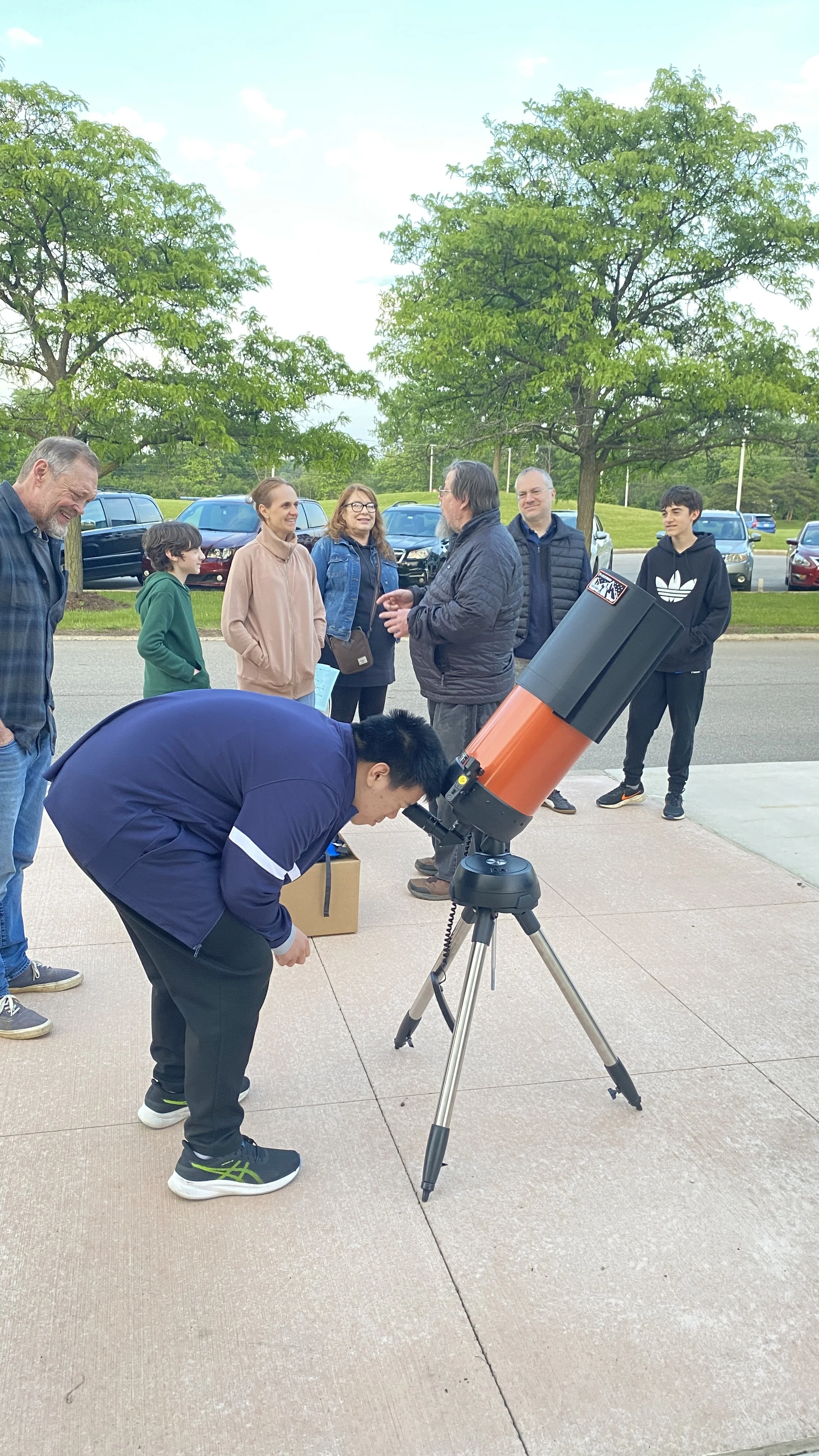
Yesterday I had the opportunity to join another stargazing event organized by the Chicago Astronomical Society.
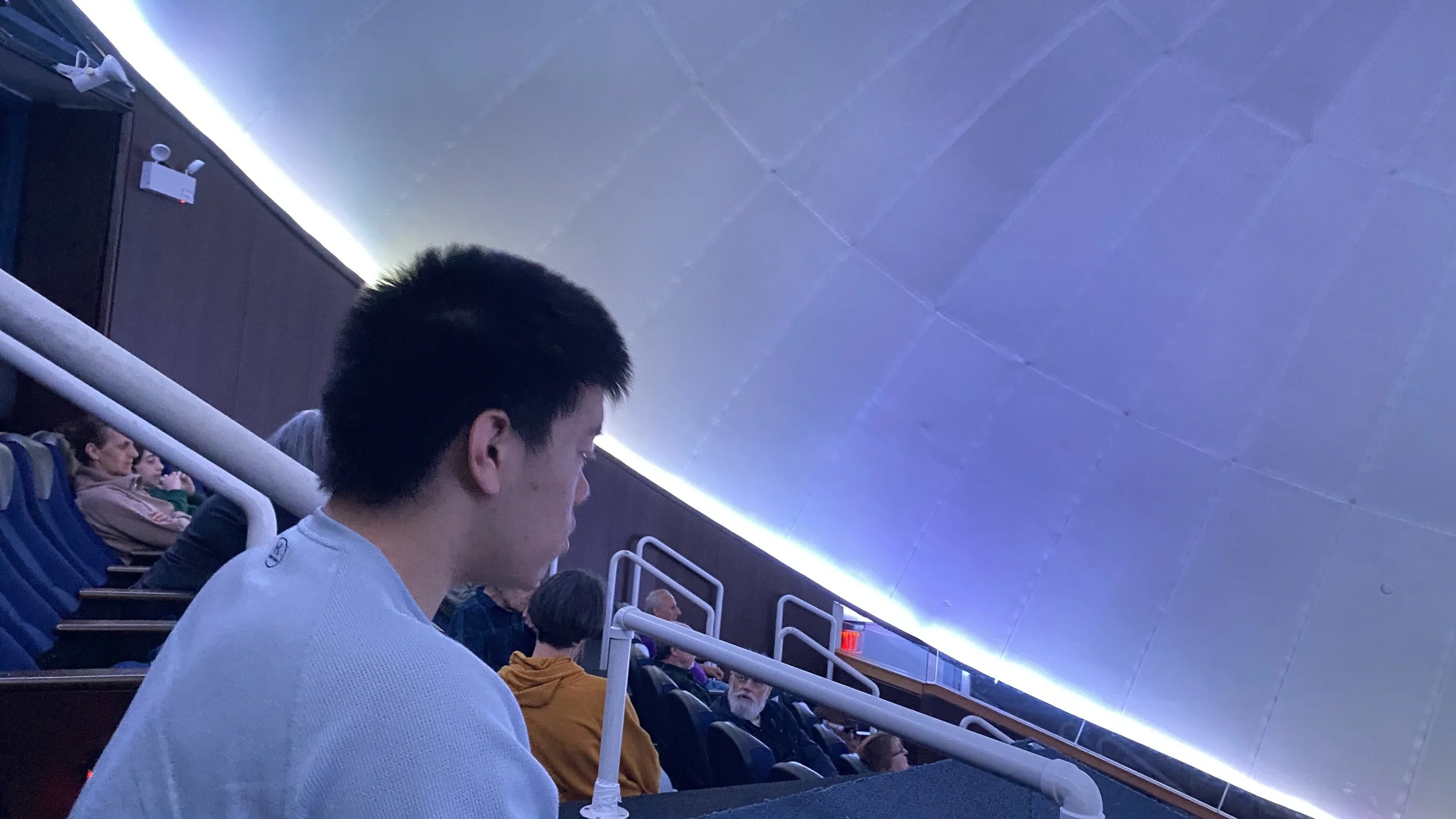
One highlight of the evening was planetarium tour at the Cernan Earth and Space Center of Triton College. During the presentation, I learned something that I found fascinating: astronomers have already discovered and studied multiple interstellar objects—objects that originated outside our Solar System. The first known example, ʻOumuamua, was discovered in 2017 by Haleakalā Observatory and tracked by observatories around the world.
What impressed me most was how scientists determined that ʻOumuamua came from beyond our Solar System. By carefully measuring its motion, astronomers found that it followed a hyperbolic orbit, meaning it was traveling too fast to remain gravitationally bound to the Sun. To me, this is a living example of how mathematics serves as the language of science. A series of observations, combined with mathematical analysis, revealed the extraordinary origin of an object millions of miles away.
Another unforgettable moment came when I looked through a telescope and saw the Moon's craters in remarkable detail. Although I have already photographed several nebulae through my own astrophotography setup, viewing a celestial object directly through a telescope felt completely different. Seeing the rugged lunar landscape with my own eyes created an immediate connection to the night sky that photographs alone cannot fully capture.
Earlier in the evening, during a group discussion, a passionate young astronomer shared the moment that inspired his love for astronomy. The first time he observed Jupiter through a telescope, he said it felt as if "a spark had been thrown into a tank full of gasoline," instantly igniting his passion for the subject. Listening to his story, I realized that this night gave me one of those "wow moments" as well. Experiences like these remind me why astronomy continues to inspire people of all ages and why I am excited to keep exploring the universe.